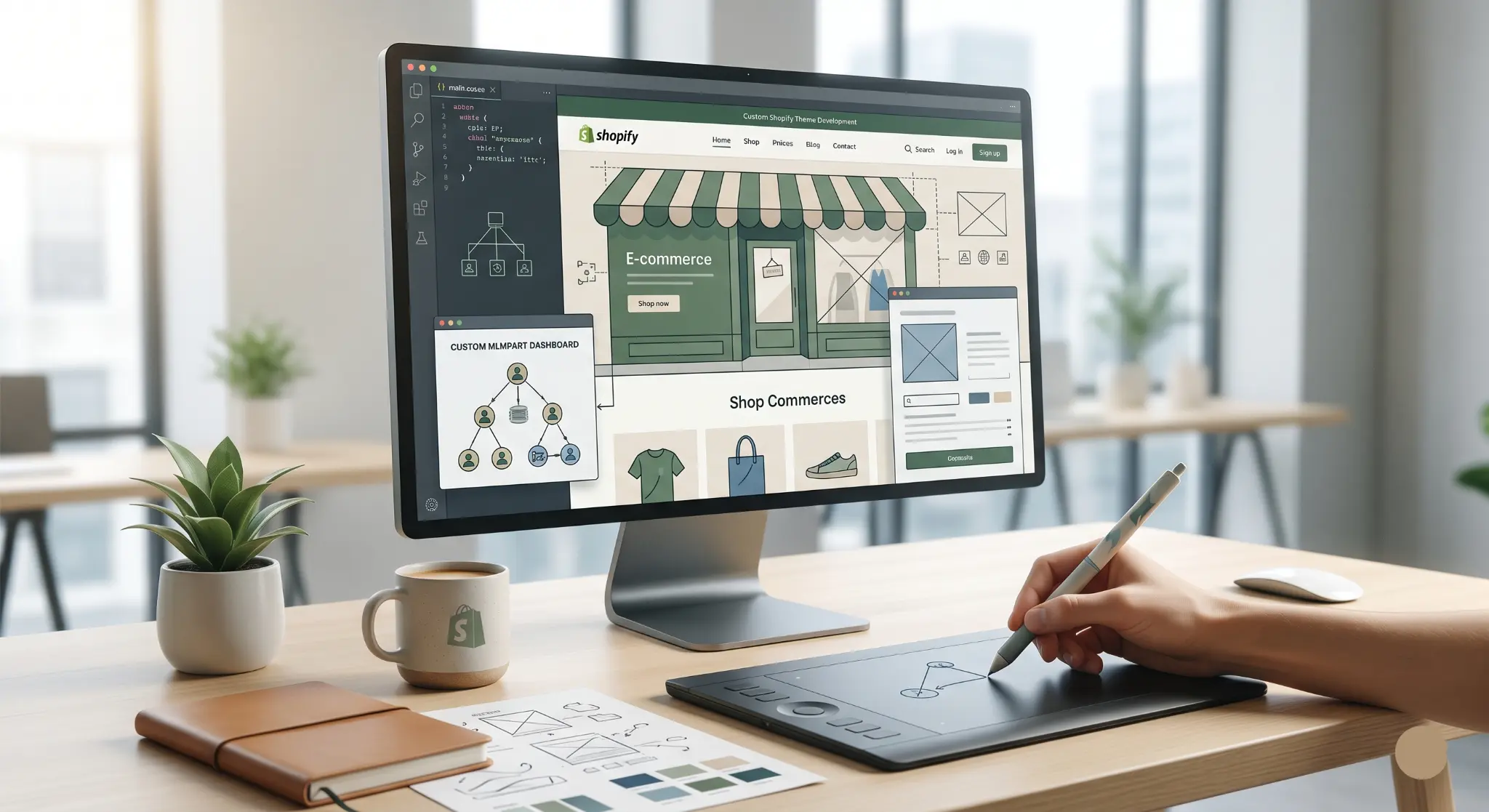
A Complete Guide to Custom Shopify Theme Development Services for Network Marketing
By the ShopifyMLM team · 12 min read
E-commerce is a fiercely competitive industry. Businesses must capture attention quickly. For multi-level marketing (MLM) and network marketing companies, the digital landscape presents even greater challenges. These organizations manage thousands of independent distributors. Each distributor requires personalized digital tools. The company must process complex multi-tier commissions. Standard online stores simply cannot support this operational weight. This report explores the necessity of a custom Shopify theme development service. It details how custom design bridges the gap between basic retail and advanced network marketing.
The Intersection of Network Marketing and E-Commerce
Shopify is a global leader in digital commerce. It manages product catalogs beautifully. It processes secure payments efficiently. It provides robust inventory tracking. However, Shopify is built for traditional retail. Natively, Shopify does not understand network marketing structures. It cannot calculate Unilevel, Binary, or Matrix compensation plans. It lacks built-in genealogy trees. It cannot manage hierarchical distributor wallets.
Network marketing companies require a bridge. This bridge connects the retail power of Shopify with the tracking power of specialized MLM software. Natively, Shopify uses a single-tier affiliate model. MLM requires multi-tier rewards. Distributors earn from personal sales and downline sales. A custom Shopify theme development service unites these two worlds. It creates a seamless front-end experience. Customers see a fast, beautiful store. Distributors access a powerful business dashboard.
The Limitations of Off-the-Shelf Shopify Themes
Many new businesses start with pre-made templates from the Shopify Theme Store. Popular options include Debut, Brooklyn, Supply, and Minimal. For basic stores, these templates work well. For enterprise MLM operations, they create significant bottlenecks.
Pre-made themes target a broad audience. Theme developers pack them with every possible feature. They include heavy JavaScript libraries and massive CSS files. Most businesses only use a fraction of these features. This excess code is called “code bloat”. Code bloat slows down page loading speeds. In digital commerce, slow speeds destroy revenue. Data shows that a one-second delay in page load time reduces conversion rates by over four percent.
Generic themes also damage brand identity. When thousands of stores use the same template, standing out is impossible. Network marketing relies heavily on brand credibility. Distributors need a professional, unique platform to attract recruits. A generic website undermines this trust.
Furthermore, pre-built themes rely on third-party apps for extra features. Installing too many apps is a common mistake. Apps often conflict with one another. They inject more code into the theme. This creates security vulnerabilities and further degrades performance.
The Strategic Value of Custom Shopify Theme Development
A custom Shopify theme development service offers a completely tailored solution. Developers build the theme from the ground up. They write code specifically for the business requirements. This approach offers massive strategic advantages.
First, custom themes deliver exceptional performance. Developers write clean, modular code. They include only essential features. This results in lightning-fast load times. Faster stores experience lower bounce rates and higher sales.
Second, custom themes provide full design control. The visual layout matches the brand perfectly. Developers customize color palettes, typography, and button placements. This creates a cohesive user journey.
Third, custom themes ensure seamless technical integration. MLM businesses use complex third-party software. Custom themes connect flawlessly with these external systems via APIs. There are no app conflicts. There are no messy workarounds.
Finally, custom themes offer enterprise scalability. An MLM company might start with one hundred distributors and grow to one million. A modular, custom-built architecture scales effortlessly. It handles massive traffic spikes without crashing.
| Feature Area | Pre-Made Shopify Themes | Custom Shopify Theme Development |
|---|---|---|
| Code Structure | Bloated with unnecessary, universal features. | Lean, clean, and built only for specific business needs. |
| Loading Speed | Average. Degrades quickly as apps are installed. | Highly optimized for rapid page rendering. |
| Brand Identity | Generic. Often resembles direct competitors. | Completely unique. Tailored to precise brand guidelines. |
| MLM Connectivity | Difficult. Requires clunky, unstable app workarounds. | Seamless. Engineered for API and Webhook data sync. |
| Maintenance | Dependent on third-party developer updates. | Fully controlled by the brand. Less long-term conflict. |
| Scalability | Limited. Struggles with enterprise-level traffic. | Enterprise-ready. Scales to millions of users. |
The Technology Stack for Modern Shopify Themes
Understanding custom themes requires exploring the underlying technology. Shopify recently transitioned to the Online Store 2.0 architecture. This shift revolutionized how developers build storefronts.
Liquid Templating Language
Liquid is the core templating language of Shopify. It bridges static HTML and dynamic store data. Liquid pulls information from the Shopify database and displays it on the screen. For example, Liquid code displays product prices, inventory levels, and customer names dynamically.
Advanced custom Shopify theme development relies heavily on Liquid mastery. Developers use Liquid to create complex product filters. They build dynamic content rendering without using heavy apps. This keeps the store running fast.
Liquid operates within a strict “context bubble”. A variable that works in a product template might fail in a collection template. Shopify only provides certain data to specific pages. Expert developers understand these rules. They write robust code that avoids rendering errors.
JSON Architecture and Modularity
Before Online Store 2.0, themes used rigid Liquid templates. Making design changes required coding knowledge. Now, Shopify uses JSON templates. JSON allows developers to build modular “sections” and “blocks”.
This is incredibly valuable for business owners. Developers code the custom sections once. Then, non-technical marketing teams can use a drag-and-drop editor. They can rearrange pages, add promotional banners, and build landing pages easily. It offers the flexibility of a page builder with the speed of a custom code base.
Modern Developer Tooling
Professional developers use a highly optimized technology stack in 2026. This ensures fast, error-free development.
Shopify CLI: The Command Line Interface is essential. It allows developers to work on their local computers. They can preview changes instantly before publishing them to the live store.
Theme Check: This is an automated testing tool. It scans Liquid code for syntax errors. It flags performance issues and enforces Shopify best practices. This guarantees clean code before launch.
Tailwind CSS: Developers use this modern framework for styling. It allows them to build highly responsive, mobile-friendly designs quickly. It avoids the large, bloated style sheets found in older themes.
Alpine.js: Older themes relied on jQuery for interactive elements like menus and pop-ups. jQuery is slow and heavy. Modern themes use Alpine.js. It is incredibly lightweight and fast.
Version Control: Developers use GitHub to track code changes. If a new feature breaks the site, they can instantly revert to a previous, stable version.
Headless Commerce: The Ultimate Customization
For massive, global MLM operations, traditional custom themes sometimes hit limits. In these cases, agencies recommend Headless Shopify architecture. Headless commerce separates the front-end user interface from the back-end Shopify engine.
In a standard setup, the front and back are fused together. Changes to one affect the other. In a headless setup, they operate independently. They communicate via application programming interfaces (APIs). The front end is often built using advanced frameworks like React.js, Next.js, or Gatsby.
The Benefits of Headless Shopify
Headless is not for everyone. It requires significant technical expertise. Businesses lose access to the native Shopify theme editor. They also lose access to many standard Shopify apps. Developers must manually build integrations for every required tool. Maintenance costs increase because the business relies entirely on a development agency for support. Headless is an enterprise solution reserved for complex, high-volume operations.
The Drawbacks of Headless Architecture
Headless is not for everyone. It requires significant technical expertise. Businesses lose access to the native Shopify theme editor. They also lose access to many standard Shopify apps. Developers must manually build integrations for every required tool. Maintenance costs increase because the business relies entirely on a development agency for support. Headless is an enterprise solution reserved for complex, high-volume operations.
Executing Shopify MLM Integration
A custom theme is only the visual layer. For an MLM company, the underlying software integration is the true engine. Shopify handles the e-commerce transaction. The MLM software handles the commission payout. 1 The integration process connects these two actions seamlessly.
Bridging the Systems
Companies like Infinite MLM, Global MLM, and ePixel offer specialized software. This software acts as the “bridge”. The integration utilizes secure APIs and Webhooks.
A Webhook is an automated message sent when an event occurs. When a customer completes a checkout on Shopify, a Webhook triggers. It instantly sends the order data, customer details, and total purchase value to the MLM backend.
There is no manual data entry. There are no batch uploads at the end of the day. The synchronization happens in real-time. This ensures that inventory levels remain accurate across both systems.
Processing Complex Compensation Plans
Network marketing uses various compensation models. The most common are Unilevel, Binary, and Matrix plans.
In a Unilevel plan, a distributor recruits people directly onto their frontline. The structure goes infinitely wide. In a Binary plan, a distributor only has two legs: a left leg and a right leg. Sales volume is compared between the two legs. Commissions are often based on the weaker leg.
Shopify cannot process this logic. The custom integration solves this. The Webhook sends the sales data to the MLM software. The software analyzes the exact genealogy tree. It applies the specific rules of the Unilevel or Binary plan. It calculates the correct commission instantly.
Real-Time Wallet Updates and Payouts
Trust is critical in network marketing. Delayed or inaccurate commissions destroy distributor morale. The custom integration prevents this.
Once the MLM software calculates the commission, it updates the distributor’s virtual wallet. The distributor logs into their dashboard. They see their new balance immediately. The integration ensures that payout rules are fully automated and error-free.
Managing Replicated Storefronts and Personalized URLs
One of the defining features of an MLM business is the replicated website. Every independent distributor needs their own digital storefront. They use this store to sell products and recruit new members.
Creating thousands of separate Shopify stores is financially impossible and operationally disastrous. Instead, custom Shopify theme development uses dynamic URL routing to create replicated storefronts from a single main website.
The Mechanics of Replication
The corporate entity maintains one central Shopify store. They manage one product catalog and one inventory database. The custom theme is programmed to recognize special tracking links.
A distributor receives a unique URL, such as shopifymlm.com/alice. When a customer clicks this link, the custom theme reads the URL parameter. Using Liquid logic, the theme dynamically changes the display.
The website still shows the corporate products. However, the header might change to say “Welcome to Alice’s Store.” It might display Alice’s photo and contact information. The customer feels they are shopping with their personal representative.
Seamless Referral Tracking
When the customer adds an item to the cart, the theme tracks the referral. It passes Alice’s unique identifier through the entire checkout process. The customer checks out using Shopify’s secure, PCI-compliant payment gateway.
Once the payment clears, the system attributes the sale to Alice. The Webhook fires, sending the data to the MLM backend. Alice receives her commission. The corporate office ships the product. The entire process is automated, seamless, and highly secure.
Leveraging the Shopify AJAX API for Dynamic Experiences
To make the storefront feel modern, developers utilize the Shopify AJAX API. This API is a set of lightweight endpoints. It allows the custom theme to talk to the Shopify database without refreshing the webpage.
Enhancing the Retail Experience
The AJAX API vastly improves the shopping experience. For example, when a customer clicks “Add to Cart,” the AJAX API updates the cart in the background. A side drawer slides open showing the new item. The page does not reload. This removes friction and keeps the customer engaged in shopping.
Developers use the AJAX API to display real-time product recommendations. As a customer types in the search bar, the API instantly suggests relevant items. It can also fetch localized pricing based on the customer’s geographic location.
Enhancing the MLM Experience
For the MLM integration, the AJAX API is incredibly powerful. Distributors need real-time data. A custom theme can use the API to pull data from the MLM backend and display it on the Shopify front end.
For example, a developer can build a custom Liquid section that displays real-time discount details or commission rates based on the distributor’s current rank. The AJAX API requests the data asynchronously. It displays the latest wallet balance or network volume right on the distributor’s dashboard without a page refresh. This creates a fast, app-like experience within the web browser.
Want to see these features in action?
Schedule a quick demo and explore order sync, commission automation, and replicated stores with your own data.
UI/UX Design Principles for MLM Storefronts
User Experience (UX) and User Interface (UI) design dictate how people interact with a website. In an integrated Shopify MLM system, the design must serve two different groups. It must serve retail customers buying products. It must also serve distributors managing their business. A custom theme ensures both journeys are flawless.
Consumer UX: Avoiding Common Mistakes
Many new store owners make critical design errors. These mistakes confuse visitors and destroy sales. A professional design agency actively avoids these pitfalls.
Cluttered Homepages: Simplicity converts. Heavy visuals and excessive animations overwhelm the user. A clean layout guides the customer smoothly toward the products.
Poor Navigation: If a customer cannot find a product, they leave. Custom themes use logical menu structures. Menu titles must be clear. No product should take more than three clicks to reach.
Ignoring Mobile Users: The majority of e-commerce traffic happens on smartphones. A store that looks great on a desktop but breaks on a phone will fail. Custom themes use mobile-first design. Padding, button sizes, and images are optimized for small touch screens.
Jarring Colors: Using overly bright, neon colors damages trust. Custom themes use sophisticated color palettes that align with brand psychology.
Weak Product Descriptions: Relying on generic supplier text hurts sales and SEO. Custom themes feature beautifully designed product pages that highlight benefits clearly.
Distributor Dashboard UX: The Product Thinking Approach
The distributor dashboard is the heart of the network marketer’s business. If the dashboard is confusing, distributors will quit. Designing effective dashboards requires a “product thinking” approach.
The layout must be logical and simple. A highly effective method is the “inverted pyramid” structure. This structure organizes information by importance.
Top Level (The Headlines): The most critical data sits at the very top. This includes the current wallet balance, active rank, and total monthly volume. Eye-tracking studies show users scan from top-left to bottom-right. Placing Key Performance Indicators (KPIs) here guarantees they are seen immediately without scrolling.
Middle Level (The Details): The center of the dashboard provides deeper context. This is where the genealogy tree is displayed. Distributors can visually explore their Unilevel or Binary downlines. This section also holds sales charts and performance graphs.
Bottom Level (Background Info): The bottom contains necessary, but less urgent, data. This includes detailed transaction logs, payout histories, and links to training resources.
By structuring the dashboard this way, the custom theme reduces cognitive load. Distributors understand their business health in seconds.
Conducting Rigorous UX Audits
Building a custom theme is an iterative process. It relies on real data, not guesswork. Elite agencies conduct comprehensive UX audits before launching a store.
A UX audit evaluates the current website or the new structural prototypes. The goal is to find pain points. A pain point is any obstacle that stops a user from buying. Analysts look at page load speeds, mobile responsiveness, and visual hierarchy.
Live testing is a crucial part of the audit. Researchers watch real people interact with the store. They observe where users get confused during navigation. They monitor the checkout flow to see where cart abandonment happens. Mandatory account creation is a massive friction point, causing nearly a quarter of all abandoned carts.
The audit results in a detailed report. Developers use this report to refine the custom theme. They eliminate friction. They optimize search bar placements. They ensure contact information is highly visible to build trust. This data-driven approach guarantees the final product converts visitors into buyers.
Mastering SEO in Custom Shopify Development
A beautiful, fast store is useless if nobody can find it. Search Engine Optimization (SEO) is vital for driving organic traffic. Pre-built themes often have poor SEO foundations. A custom Shopify theme development service builds SEO directly into the code.
Technical SEO Fundamentals
Custom themes optimize the underlying HTML structure. This helps search engine bots crawl and index the site easily.
Optimized Code: Clean code without excessive scripts allows Google bots to render the page faster. Site speed is a direct ranking factor.
Dynamic Meta Tags: Developers use Liquid to generate dynamic titles and descriptions. The
{{ page_title }}tag ensures every page has a unique, descriptive HTML title tag in thetheme.liquidfile. This prevents duplicate title errors.Structured Data (Schema Markup): Custom themes embed JSON-LD schema markup. This code speaks directly to search engines. It highlights product prices, review ratings, and stock status. This enables Google to display “rich snippets” in search results, dramatically increasing click-through rates.
Image Optimization: Developers code the theme to handle image file names and ALT text properly. Descriptive image names help the store rank in Google Image search.
Solving the Replicated Store Duplicate Content Problem
For MLM companies, SEO presents a massive, specific risk: duplicate content.
Because distributors use replicated storefronts, the exact same product description exists on hundreds of different URLs. For example, brand.com/distributor-a/product and brand.com/distributor-b/product show the exact same content.
Search engines hate duplicate content. If Google sees the same text on multiple pages, it does not know which page to rank. It often penalizes the entire website, dropping its search rankings drastically. Furthermore, duplicate URLs split “link equity.” If external websites link to different distributor pages, the ranking power is diluted.
A custom Shopify theme solves this instantly using Canonical Tags.
Developers write Liquid logic in the theme code. This code places a <link rel="canonical"> tag in the hidden header of every page. Regardless of which distributor URL a customer visits, the canonical tag points directly to the main, corporate product URL.
This tells Google: “Ignore all the replicated versions. Give all the SEO credit and ranking power to this one main product page.” This entirely eliminates the duplicate content penalty. The store ranks higher, while distributors still get to use their personalized links.
Incorporating LSI Keywords Naturally
Search engines use Artificial Intelligence to understand content. They no longer look for exact keyword matches. They analyze Latent Semantic Indexing (LSI) keywords.
LSI keywords are closely related terms. They give context to the main topic. For example, if a page is about “Shopify Custom Theme Development,” search engines expect to see LSI keywords like “Liquid Language,” “Shopify CLI,” “UI/UX design,” “mobile-responsive,” and “e-commerce SEO”.
Including these terms proves to Google that the content is comprehensive and authoritative. A custom theme provides specialized text blocks and blog layouts. These areas allow content creators to weave LSI keywords naturally into the text. This improves the overall user experience and boosts rankings across dozens of related search queries.
The Custom Theme Development Process
Building an enterprise-grade custom theme requires a structured, professional workflow. Agencies follow a strict process to ensure quality and prevent delays.
Discovery and Consulting: The process begins with deep analysis. Developers meet with the business owners. They analyze the brand identity, target audience, and current conversion bottlenecks. They map out the specific MLM software integration requirements.
Wireframing and Prototyping: Designers create structural blueprints of the store. They build interactive prototypes. This allows stakeholders to visualize the user journey and navigation flow before coding begins. UX testing often happens at this stage.
Core Development: Developers write the code. They set up the Shopify CLI. They build the JSON sections, Liquid templates, and Tailwind CSS styles. They implement the AJAX API for dynamic cart updates. They configure the Webhooks connecting Shopify to the MLM backend.
Quality Assurance (QA) Testing: Rigorous testing is mandatory. The QA team uses Theme Check to lint the code. They test the store across all major browsers (Chrome, Safari, Edge) and mobile devices (iOS, Android). They run speed audits and verify accessibility compliance. They place test orders to ensure the Webhooks trigger correctly and commissions calculate accurately.
Deployment and Go-Live: The final code is pushed to the live Shopify environment. Agencies often perform this during low-traffic hours to minimize disruption.
Post-Launch Support: E-commerce is constantly evolving. Professional agencies provide ongoing maintenance. They monitor site speed, update integrations, and add new custom features as the business scales.
Analyzing the Financial Impact and ROI
A custom Shopify theme development service requires an upfront investment. A full enterprise build from scratch typically takes between 8 to 12 weeks. The cost ranges from $15,000 to $50,000.
For comparison, enterprise-tier MLM software subscriptions (like Global MLM) can cost up to $3,000 per month for unlimited users. Building a robust digital infrastructure is a major financial decision.
However, the Return on Investment (ROI) is rapid and substantial. Custom themes pay for themselves by directly increasing revenue and reducing operational friction.
Real-World Case Studies
Empirical data from development agencies proves the value of custom builds.
One case study examined an established direct-to-consumer brand struggling with a 69.99% cart abandonment rate. After migrating to a custom Shopify theme, the results were dramatic. The brand saw a 37% increase in overall conversion rates within just three months. The streamlined, custom checkout flow caused cart abandonment to drop by 22%. Furthermore, the cleaner code resulted in 50% faster page load times. This kept users engaged, leading to a 15% increase in the Average Order Value (AOV).
Another case study highlighted the fashion brand Aje. They migrated to a custom Shopify Plus setup. They focused heavily on mobile optimization. By removing a clunky checkout and implementing responsive design, their conversion rate skyrocketed by 135%. Bounce rates fell, and shoppers viewed more pages per session.
The WeCanFly agency portfolio highlights similar massive successes. When the brand Le Collet implemented a custom Shopify Plus build, they experienced a 300% sales increase within 24 hours. The furniture manufacturer Vetsak saw a nearly 100% increase in conversions after their custom migration, allowing them to expand globally.
These case studies illustrate a fundamental truth. A website is not just a digital flyer. It is a sales machine. When the friction is removed, customers buy more.
Long-Term Cost Efficiency
Beyond immediate sales growth, custom themes save money over time. Pre-made themes often require dozens of monthly app subscriptions to achieve basic functionality. These monthly fees add up quickly. A custom theme builds these features natively into the code, eliminating recurring app costs.
Furthermore, custom code is stable. It requires less emergency maintenance. When external apps update, they frequently break pre-made themes. A custom, closed-ecosystem theme remains secure and functional. This stability is crucial for MLM companies that cannot afford downtime during massive end-of-month sales pushes.
Integrating Alternative Platforms
While Shopify is the industry leader, a custom development strategy must acknowledge the broader ecosystem. MLM software providers integrate with multiple e-commerce platforms to suit different business needs.
WooCommerce: Built on WordPress, WooCommerce offers high flexibility. Integrating WooCommerce MLM software allows for automated financial reconciliation and real-time inventory management. However, WooCommerce requires the business to manage its own servers and security protocols.
Magento: Magento is an enterprise-grade open-source platform. A Magento MLM software integration excels at managing massive, complex product catalogs. It is highly customizable but requires significant development resources to maintain.
BigCommerce: Similar to Shopify, BigCommerce is a hosted SaaS platform. It handles large volumes well and connects deeply with MLM APIs to maximize operational efficiency.
Despite these alternatives, Shopify remains the preferred choice for most modern MLM businesses. Its balance of security, speed, and API flexibility makes it the ideal foundation for custom theme development.
Conclusion
The network marketing industry moves quickly. Distributors demand modern, fast, and reliable tools. Retail customers expect seamless, friction-free shopping experiences. Attempting to run a complex MLM operation on a generic, bloated website template is a recipe for stagnation.
A custom Shopify theme development service fundamentally transforms the business. By leveraging the Online Store 2.0 architecture, writing clean Liquid code, and integrating seamlessly via APIs and Webhooks, businesses achieve operational excellence.
Custom design eliminates cart friction. It presents personalized replicated storefronts flawlessly. It provides distributors with logical, data-rich dashboards. Furthermore, by structuring the code correctly, it protects the business from severe SEO penalties associated with duplicate content.
The initial investment in custom development yields massive returns. Case studies prove that clean architecture leads to faster speeds, lower abandonment rates, and drastically higher conversions. For an MLM company focused on aggressive growth, a custom Shopify theme is not an optional luxury. It is the foundational digital asset required for long-term success.
Curious how this will work for your store?
Book a 15-minute demo and we'll map your Shopify setup to the MLM plan. Includes a free data sync audit.
Author: ShopifyMLM Team · Updated April 2026 — helping MLM brands connect Shopify to network marketing since 2018.
On this page