
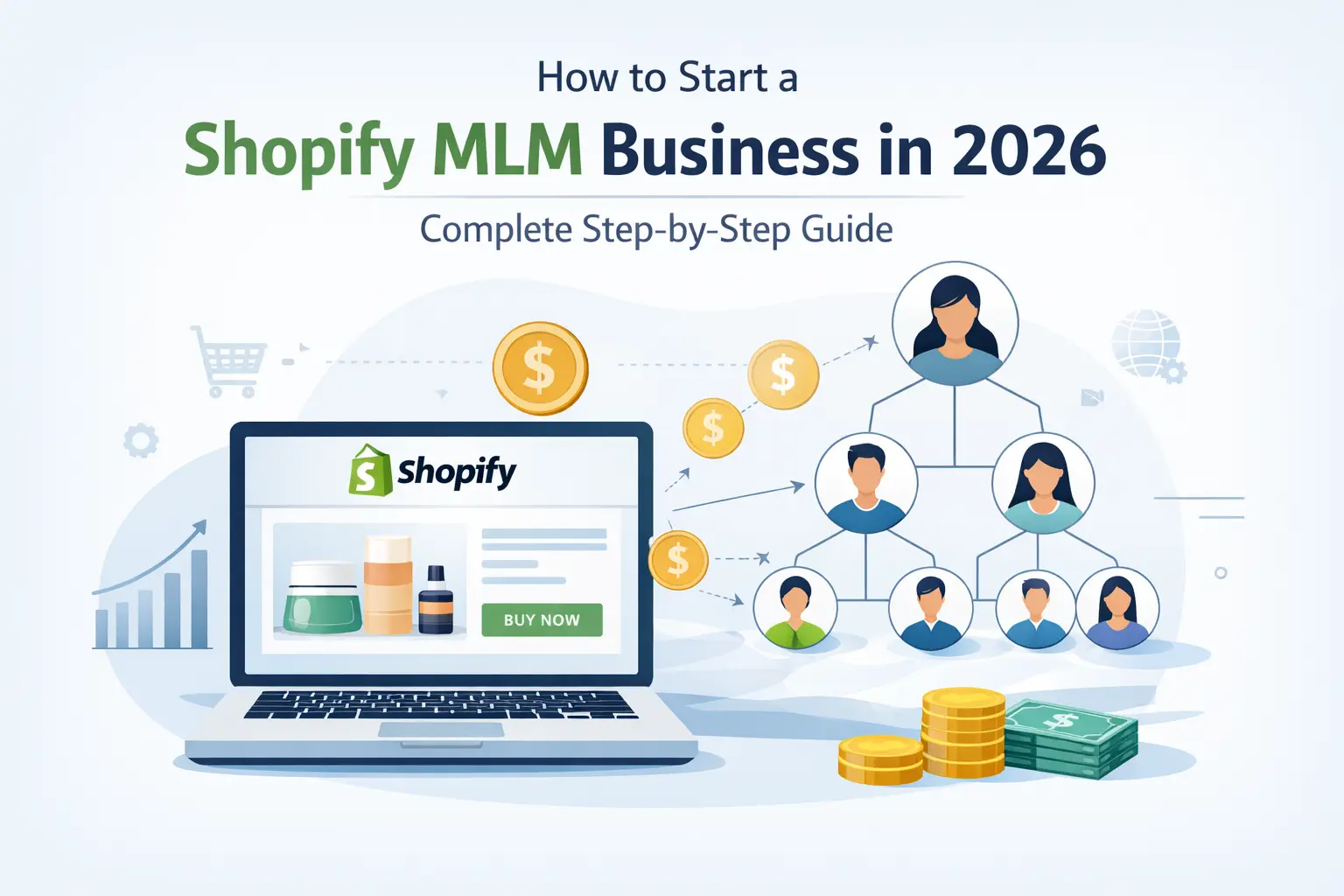
How to Start a Shopify MLM Business in 2026 — Complete Step-by-Step Guide
By the ShopifyMLM team · 12 min read
E-commerce and network marketing are converging faster than ever. In 2026, brands that combine a Shopify storefront with a multi-level commission engine can scale sales, reward loyal distributors, and automate payouts — all from one platform.
But Shopify doesn’t include MLM tools out of the box. You need the right Shopify MLM software to bridge the gap. This guide walks you through every step — from setting up your store to onboarding distributors and going live. We’ll also link to a free demo so you can see it in action.
What Is a Shopify MLM Business?
A Shopify MLM business is simply a Shopify store connected to a third-party MLM backend. Shopify handles the storefront, checkout, and payments. The MLM layer adds replicated storefronts, referral tracking, downline management, and a commission engine that calculates multi-tier payouts.
Each distributor gets a personal link or replicated store tied to your main catalogue. When a customer buys through that link, the order syncs to the MLM engine. Commissions flow up the tree — level 1, level 2, and beyond — based on your compensation plan.
Think of it as two systems working in tandem: Shopify for commerce, the distributor portal for everything network-marketing.
Why Choose Shopify for MLM?
Shopify powers millions of stores worldwide. It’s reliable, well-supported, and scales from small startups to enterprise brands on Shopify Plus.
- Checkout you can trust. Shopify’s checkout is PCI-compliant, conversion-optimised, and supports multi-currency.
- App ecosystem. Thousands of apps for marketing, fulfilment, and analytics — including Shopify MLM integration tools.
- Scalability. Start small and grow. Shopify handles traffic spikes, and the MLM plugin scales alongside it.
Quick example: Imagine “FreshGlow,” a wellness brand. They ran their store on Shopify but tracked commissions in spreadsheets. After adding an MLM integration, admin time dropped by roughly 60% and distributor onboarding went from days to minutes.
The gap? Shopify doesn’t include commission logic, genealogy trees, or replicated storefronts. That’s why you need dedicated Shopify MLM software.
Tools You Need: Shopify Store + MLM Software
Before you begin, make sure you have these pieces in place:
- Active Shopify account — any plan works, though Plus is better for large networks.
- MLM plugin or integration — the engine that handles commissions, genealogy, and replicated stores. See Shopify MLM Software for an overview.
- Compensation plan design — unilevel, binary, matrix, or hybrid. Know your percentages and ranks.
- Payment gateway — Shopify Payments or a third-party provider for distributor payouts.
- Analytics setup — track orders, commissions, refunds, and distributor performance from day one.
The MLM engine connects to Shopify via webhooks for real-time order sync. When a customer checks out, the data flows to the commission engine instantly — no manual entry, no delays.
| Factor | Manual Tracking | Shopify + MLM Integration |
|---|---|---|
| Admin time | Hours per week | Minutes per week |
| Accuracy | Error-prone | Automated & auditable |
| Scalability | Breaks at ~50 reps | Handles thousands |
| Cost | Hidden labour costs | Predictable subscription |
Step-by-Step: How to Start a Shopify MLM Business in 2026
Follow these seven steps. Each one builds on the last.
Step 1 — Set Up Your Shopify Store
Create your Shopify store if you haven’t already. Add your products, choose a clean theme, set up your domain, and configure policies (shipping, returns, privacy). Make sure your checkout works smoothly before adding MLM features.
Pro tip: Use high-quality product images and clear pricing. Distributors will share your store — first impressions matter.
Step 2 — Choose the Right Shopify MLM Integration
Not all MLM plugins are equal. Look for these essentials:
- Real-time order sync (webhooks, not batch imports).
- Flexible compensation plans (unilevel, binary, matrix, hybrid).
- Replicated storefronts with distributor branding.
- Mobile-friendly distributor portal.
- Refund-aware commission reversals.
- PCI-DSS compliance and encrypted APIs.
Read the full MLM software guide for a deeper feature comparison.
Step 3 — Install & Connect
Install the MLM app from the vendor’s site or the Shopify App Store. Authenticate with your Shopify admin, grant API access, and verify webhooks. Run a test order end-to-end — place a sample order and confirm the commission engine picks it up.
Step 4 — Configure Your Compensation Plan
This is where strategy meets software. Set your plan type and payout rules. For example, a unilevel plan might pay 10% on level 1, 5% on level 2, and 3% on level 3.
Define rank qualifications, bonuses, caps, and how refunds affect payouts. Test multiple scenarios with dummy data before going live.
Step 5 — Onboard Distributors
Set up a signup flow. Each distributor should receive a replicated storefront, a unique referral link, and a personal discount code. Provide training materials — short videos work best — covering how to share links, track commissions, and use the distributor portal.
Step 6 — Launch & Market
Announce your launch to existing customers and social followers. Run early-bird incentives for distributors. Share content on social media and encourage distributors to do the same. SEO and paid ads help, but word-of-mouth is MLM’s superpower.
Step 7 — Monitor & Iterate
Use your MLM dashboard to review analytics & reporting: sales volume, commission payouts, distributor activity, and refund rates. Adjust bonuses, add new ranks, or tighten caps based on real data. Schedule monthly compliance checks.
Curious how this will work for your store?
Schedule a quick demo and see order sync, commissions, and replicated stores in action.
Key Features to Demand from Shopify MLM Software
When evaluating vendors, insist on these must-haves:
- Real-time order sync — orders, refunds, and customer data should flow instantly via webhooks.
- Flexible commission engine — support for unilevel, binary, matrix, and hybrid plans with configurable ranks and bonuses.
- Replicated storefronts — branded personal stores for every distributor, linked to your main product catalogue.
- Mobile distributor portal — distributors should manage their team, view commissions, and share links from any device.
- Analytics & reporting — real-time dashboards for sales, payouts, team growth, and refund tracking.
- Automatic refund reversal — when a Shopify refund is processed, commissions should reverse automatically.
- Security & compliance — PCI-DSS, GDPR readiness, encrypted APIs, and role-based access for distributor data.
- Multi-currency support — accept and pay out in multiple currencies for global networks.
- API access — for custom integrations, data exports, and third-party tool connections.
Common Pitfalls and How to Avoid Them
MLM launches go sideways when you skip the basics. Here are the most common mistakes:
- Skipping the test phase. Always run end-to-end test orders. Check commissions, refunds, and edge cases before onboarding real distributors.
- Overly complex comp plans. Start simple. A complicated plan confuses distributors and creates support headaches. You can add tiers and bonuses later.
- Ignoring refund handling. If your software doesn’t reverse commissions on refunds, you’ll overpay and lose money quietly.
- Choosing software that doesn’t scale. Ask about API rate limits, concurrent users, and Shopify plan compatibility before you commit.
Bottom line: invest a few extra days in testing and planning. It saves weeks of firefighting after launch.
Frequently Asked Questions
Can I run MLM on Shopify without extra apps?
No. Shopify does not include multi-level commission logic natively. You need an MLM integration or plugin to add replicated storefronts, commission engines, and downline tracking.
Which Shopify plan do I need for MLM?
Most MLM plugins work on standard Shopify plans. However, Shopify Plus offers higher API limits and checkout customisation — useful for larger distributor networks.
Which compensation plans work with Shopify MLM software?
Most modern integrations support unilevel, binary, matrix, and hybrid plans. You configure percentages, ranks, and bonus rules inside the MLM engine — no coding needed.
How are commissions calculated and paid?
Orders placed through a distributor link sync to the MLM engine, which calculates payouts per your rules. Many systems support auto-payouts to wallets or payment providers and handle refund reversals automatically.
How are refunds handled?
Good MLM software reverses the related commissions automatically when a Shopify refund is processed. This keeps your payout ledger accurate without manual adjustments.
Is it secure and compliant?
Ready to Launch?
Starting a Shopify MLM business in 2026 is simpler than you think — if you have the right tools. Pick a solid Shopify MLM integration, design a fair compensation plan, and test before you go live.
The steps in this guide give you a clear roadmap. And if you’d like to see commission automation, replicated storefronts, and real-time order sync in action, the easiest next step is a demo.
Ready to scale with the best Shopify MLM software in 2026?
Book a live demo now. See order sync, commissions, and replicated stores — all running on your Shopify data.
Includes a free data sync audit.
Author: ShopifyMLM Team • Updated March 2026. ShopifyMLM helps brands connect Shopify stores to powerful MLM engines — commission automation, replicated storefronts, and distributor management, all in one integration.