The Complete 2026 Guide to Shopify Network Marketing Software and Integrations
By the ShopifyMLM team · 12 min read
The world of online shopping is growing at an incredible speed. By the end of 2026, global e-commerce sales are expected to reach a staggering $6.88 trillion. As more money flows through digital channels, traditional business models are adapting to keep up. One of the most powerful combinations in the modern business world is the pairing of direct sales with robust e-commerce platforms. The direct selling industry already generates over $201 billion in annual revenue. Meanwhile, Shopify powers more than 4.4 million online stores across the globe.
Bringing these two powerhouses together seems like an obvious choice. However, there is a major technical hurdle. Shopify is built for traditional retail. It does not natively support multi-tier commission structures, downline tracking, or complex genealogy trees. If you want to reward independent distributors for their personal sales and the sales of their recruited team members, a standard store simply cannot handle the math.
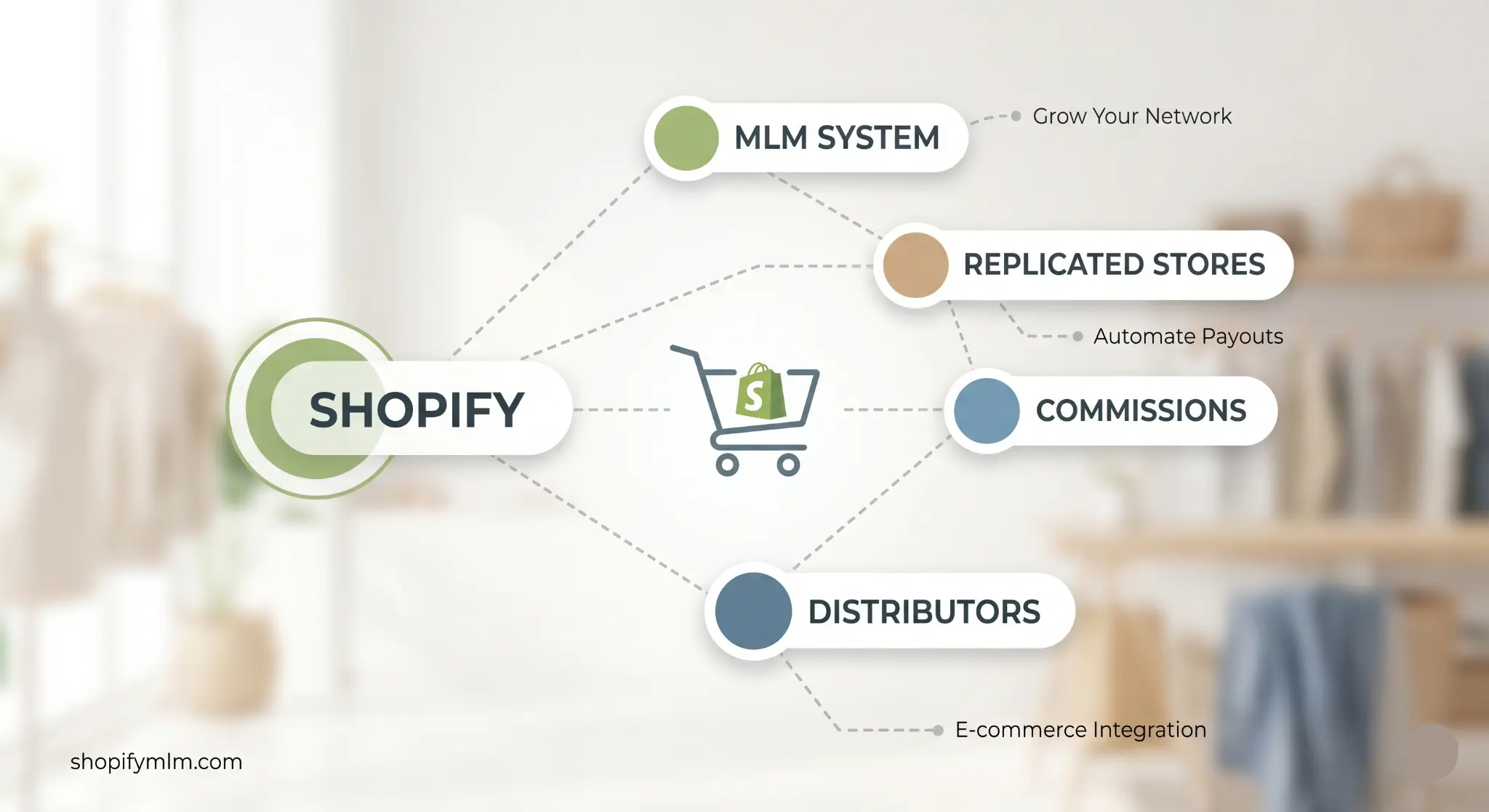
To solve this problem, smart business owners use specialized affiliate software for shopify. These powerful integration tools bridge the gap. They transform a basic online store into a fully automated network marketing machine. This comprehensive report explores everything you need to know about setting up, launching, and scaling a direct sales business online in 2026. We will cover the technical details, the most effective compensation plans, the top software vendors, and the marketing strategies that actually work.
The Technical Blueprint of a Seamless Integration
Standard affiliate programs are very simple. A person shares a link, a customer buys a product, and the person earns a small flat fee. Network marketing is much more complex. A single sale might trigger payouts for three, five, or even ten different people in a referral chain. Because Shopify cannot do this out of the box, you need third-party mlm soft to do the heavy lifting. A professional integration relies on several core technologies working together in the background.
Referral links and tracking
The most important feature of any integration is real-time synchronization. When a customer checks out on your store, the data must move instantly. Professional platforms use secure tools called webhooks and APIs to make this happen.
Think of a webhook as a digital messenger. The moment an order is confirmed, the webhook instantly grabs the order details. It takes the customer information, the products purchased, and the unique referral tag. It immediately delivers this package to your external mlm software. The software receives the message, looks at the referral tag, and finds the correct distributor. It then calculates all the multi-level commissions in a fraction of a second. This instant communication means you never have to download spreadsheets or upload CSV files manually.
Replicated Distributor Storefronts
If you want your distributors to succeed, you must give them the right tools. The most critical tool is a replicated storefront. When a new representative joins your team, the software automatically creates a personalized version of your main store just for them.
This store usually has a unique web address, such as yourbrand.com/alice. When a customer shops through Alice’s link, they see the exact same products, prices, and branding as the main corporate site. However, the software secretly tracks every click and purchase. Every single sale is perfectly tracked back to Alice. The best part is that all payments still flow through your main, secure Shopify checkout. You maintain total control over the money, the inventory, and the shipping process.
Automated Refund and Cancellation Handling
Running a business means dealing with refunds. In a multi-level structure, a refunded order can cause a massive headache. If you pay five different people a commission on a sale, and the customer returns the item a week later, you lose money. You must recover those commissions to keep your books accurate.
High-quality shopify affiliate marketing tools handle this automatically. When you process a refund in your store dashboard, the webhook sends another message to the commission engine. The software instantly locates the original payout and reverses the commissions across the entire upline. This automated ledger adjustment protects your business from accidental overpayments and keeps your financial records perfectly clean.
Mobile-Friendly Dashboards
Your distributors are likely running their businesses from their smartphones. They need to see their numbers at a glance. Modern software provides beautiful, mobile-friendly portals for every representative. When they log in, they can see their real-time earnings. They can view their team’s performance, grab their unique sharing links, and check their progress toward the next rank. If a distributor cannot easily understand their earnings on a mobile screen, they will lose motivation and quit. A clean, easy-to-read dashboard is absolutely essential for team retention.
Decoding Compensation Plans for E-Commerce
The mathematical rules that decide how people get paid are called the compensation plan. Choosing the right plan is one of the most important decisions you will make. The plan dictates how fast your company grows and how your team behaves. Different plans work better for different types of products. Your chosen affiliate tracking software must be flexible enough to handle the specific rules you set.
The Unilevel Plan: Simple and Powerful
The Unilevel plan is widely considered the best choice for e-commerce businesses. It is incredibly simple to explain, which makes it easy for new recruits to understand. In this structure, every single person you recruit is placed directly on your first level. This is called your frontline.
There are no limits to how many people you can place on your frontline. Your team can grow as wide as you want. The company pays commissions down to a set number of levels, such as five, seven, or ten levels deep. Because there are no complicated “legs” to balance, it is very stress-free for the distributors. This structure is a perfect match for brands selling physical items, health supplements, cosmetics, or any product that relies heavily on repeat customer purchases.
The Binary Plan: Built for Speed
If your goal is lightning-fast growth, the Binary plan is a popular choice. This plan is a bit more complex. You are only allowed to have two people on your frontline. These two people form a “Left Leg” and a “Right Leg”.
If you recruit a third person, you cannot place them on your frontline. You must place them underneath one of your first two recruits. This creates a “spillover” effect. Your new recruits actually help build the teams of the people who joined before them. This creates massive excitement and momentum.
Commissions in a binary system are usually based on the sales volume of the weaker leg. This rule forces strong leaders to step in and help their struggling team members. Because binary plans can grow so fast, the software must include safety features. Advanced systems use automated daily payout caps to ensure the company never pays out more money than it brings in.
The Matrix Plan: Structured and Controlled
The Matrix plan is highly organized. It uses a fixed width and a fixed depth. For example, a “3×3 Matrix” means you can only have three people on your frontline, and you earn commissions three levels deep.
Once your three frontline spots are full, your fourth recruit automatically spills over into the second level. This creates a very neat, predictable structure. Because growth is tightly controlled, it is very sustainable. This plan is frequently used by companies selling digital products, subscription boxes, or exclusive membership programs.
Custom and Hybrid Structures
Many enterprise companies do not want to be locked into just one model. They use Hybrid plans to get the best of both worlds. A company might use a simple Unilevel structure to pay out standard retail commissions, but use a Binary structure to pay out special leadership bonuses at the end of the month. The best software platforms provide rule-based engines. These engines let business owners mix and match rules, set specific rank requirements, and offer matching bonuses without needing to hire a custom programmer.
A Step-by-Step Guide to Launching Your Platform
Building a direct sales network requires careful planning. You cannot simply install an app and hope for the best. Professional development agencies follow a strict, proven process to ensure the launch is smooth and error-free. If you are working with an expert team, you can expect the project to follow five distinct phases.
Phase 1: Requirement Analysis
The project always starts with a deep dive into your business goals. The developers will sit down with you to review your product catalog and pricing margins. Together, you will finalize the exact mathematics of your compensation plan. This is the time to decide if you want a binary or unilevel structure. You will document every single payout percentage, rank requirement, and special bonus rule.
Phase 2: Store Setup and Optimization
Before touching the commission engine, the main storefront must be perfect. The team will organize your product SKUs, configure shipping rules, and set up your payment gateways. If you already have a successful, active store, the developers will prepare it for the new integration without causing any downtime for your current customers. Clean product data is essential for accurate tracking later on.
Phase 3: Installation and Connection
This is where the technical magic happens. The custom app is installed and securely connected to the commission engine via API. The developers establish encrypted data transfers to protect sensitive customer information. They also install anti-fraud measures to ensure that no one can manipulate the referral links.
Phase 4: Configuration and Rigorous Testing
Once the systems are talking to each other, the administrators program your specific rules into the software. They create test distributor accounts and build dummy genealogy trees. Then, the testing begins. The team will run dozens of test orders through the checkout. They will process fake refunds to ensure the reversal logic works perfectly. They will check the wallets to ensure the math is absolutely flawless. This phase is critical because a mistake in commission math can destroy a company’s reputation overnight.
Phase 5: Go Live and Train Your Team
After all tests pass, the system is ready for the public. A soft internal launch is usually conducted first. The software provider will hand over the keys and supply your team with training documentation. They will show your new distributors how to log in, grab their links, and track their sales. Premium providers offer 24/7 support during this phase to catch any minor issues immediately. To give you an idea of the investment required, development agencies like TRooInbound offer tiered pricing for the store setup portion. A basic store setup begins at $699, a standard setup with unlimited pages and abandoned cart recovery runs $999, and an advanced store with custom ERP integration costs $1499. They also offer hourly developer hiring models at $30 per hour. This shows that professional assistance is highly accessible for startups.
Want to see these features in action?
Schedule a quick demo and explore order sync, commission automation, and replicated stores with your own data.
Finding the Best Software: The Vendor Landscape
Choosing the right technology partner is the most important decision you will make. The market is full of different vendors, but they all specialize in different things. Some focus on heavy math, some focus on marketing, and some focus on keeping things simple. Let us look at the top players in the industry for 2026.
ShopifyMLM.com: The Premier Choice
For the vast majority of e-commerce brands, ShopifyMLM.com stands out as the ideal solution. Their software acts as a necessary bridge, perfectly combining storefront capabilities with an automated backend engine. They are incredibly strong in the Unilevel space. Their unilevel engine is designed to be straightforward and completely stress-free, making it perfect for product-based stores. The system automatically calculates multi-tier payouts immediately upon sale and supports completely customized rule structures. Every single distributor receives a branded, replicated storefront. The inventory and order data sync back and forth in real-time. They also provide built-in multi-currency and multi-language support, allowing your team to sell internationally without headaches. To top it off, they use AI-driven predictive analytics to help you identify your top performers before they even reach the top ranks. They offer a 14-day free trial with no credit card required, making them a very low-risk, high-reward option.
Infinite MLM Software: The Global Giant
If you are building a massive international enterprise, Infinite MLM Software is a heavyweight contender. They have over 17 years of experience and have deployed systems in more than 100 countries.
Their platform is an absolute powerhouse. It can process over one million transactions every month. They support highly complex structures like Matrix, Board, Monoline, and Stair-Step breakaway plans. They also offer modern financial tools, including the ability to accept payments and pay commissions in cryptocurrencies like Bitcoin and Ether. Furthermore, they have a built-in Learning Management System (LMS) so you can train your massive distributor army directly inside the software.
Epixel MLM Software: The Marketing Innovator
Epixel focuses heavily on making the distributor experience fun and engaging. They know that if representatives are bored, they will leave. Epixel builds gamification directly into the dashboard. They use leaderboards, performance badges, and fun quizzes to keep the team motivated.
They also offer a brilliant “smart marketing suite”. This includes omnichannel tracking and social media listening tools, allowing distributors to see exactly who is talking about the brand online. Epixel even integrates AI chatbots for customer support and tracks Customer Satisfaction Scores (CSAT) alongside sales data. This ensures your team is not just selling, but actually making customers happy.
Fenizo MLM Software: The Compliance Expert
Operating in the United States requires strict adherence to Federal Trade Commission (FTC) guidelines. Fenizo MLM Software specializes in the USA market and focuses heavily on legal compliance.
Their software includes special FTC-friendly income disclosure tools. They enforce strict KYC (Know Your Customer) verifications to prevent fraud. They also provide sophisticated tax reporting tools to keep your business out of trouble. Technically, they are very strong. They offer a highly advanced “Smart Spillover” engine for binary plans, using depth-first placement logic to maximize team momentum. They also offer custom backend builds using Node.js or Laravel for ultimate scalability.
Global MLM Solution and ByDesign Technologies
Global MLM Solution is fantastic for brands that rely heavily on social media. Their platform integrates deeply with Facebook, Instagram, and WhatsApp. This allows distributors to share their replicated links directly into social chats with one click, making the sales process incredibly smooth.
ByDesign Technologies offers a product called Freedom MLM Backoffice. They are known for providing a Single Sign-On (SSO) experience. A representative can log into their normal Shopify “My Account” page and instantly access their back office without needing a second password. They also provide actionable coaching alerts, pinging distributors when it is time to follow up with a past customer.
Specialized CRM Tools: Simple Affiliate and Simple Prospect
Sometimes you do not need a massive enterprise platform. You just need tools to help your team manage their contacts. Applications like Simple Affiliate and Simple Prospect are excellent add-ons.
Simple Prospect acts as a dedicated CRM for network marketers. It allows distributors to scan physical business cards with their phone camera and instantly add the contact to the database. It features mass texting capabilities, allowing a leader to send a single message that automatically personalizes the greeting for hundreds of team members. It also tracks product order reminders, telling the distributor exactly when a customer is likely to run out of their supplement or cosmetic product.
The Real-World Impact: A Financial Case Study
It is easy to talk about features, but what happens when a company actually installs this technology? Does it really make a difference? A recent case study focusing on a health and nutrition brand provides hard numbers.
This nutrition company was originally running a standard, single-level online store. During the pandemic, competition in the wellness space exploded. The company was spending too much money on traditional advertising and needed a new way to acquire customers. They decided to switch models. They integrated Epixel’s software with a Shopify store and launched a Unilevel network marketing program.
They gave every affiliate a replicated website, implemented a real-time commission engine, and used automated, gamified training to get new recruits up to speed quickly. The results of this transition were spectacular across every single business metric.
Marketing Strategies That Win in 2026
Having the best software in the world is useless if nobody visits your store. The digital marketing landscape has changed dramatically in the last few years. Old strategies simply do not work anymore. To thrive in 2026, you must adapt to how modern consumers discover and buy products.
Generative Engine Optimization (GEO)
Search Engine Optimization (SEO) used to be about stuffing keywords onto a page. That era is over. In 2026, the focus is on Generative Engine Optimization, or GEO. Today, search engines use artificial intelligence to read pages and summarize answers directly for the user.
If you want your store to be found, your content must clearly and directly answer common customer questions. You must also use structured data, which is hidden code that tells the search engine exactly what your product is, how much it costs, and what its star rating is. Your website must load incredibly fast. Google now judges sites heavily on visual stability and speed, so you must compress your images and delete any old, unused apps that slow down your checkout.
Email and SMS Automation
Social media gets all the attention, but email marketing is the quiet giant of the industry. The digital landscape shifted rapidly in 2025, but email remained the most stable and profitable channel. Analysts predict there will be nearly 5 billion email users globally by 2028.
Email marketing is highly cost-effective, taking up only about 7.8% of a total marketing budget but delivering an incredible return on investment of $36 for every single dollar spent. Smart brands use data platforms to automatically send highly personalized emails based on a customer’s exact browsing history.
Alongside email, SMS text marketing is becoming essential. Text messages grab immediate attention. If you want a customer to leave a review, sending an SMS request converts 66% higher than sending an email request.
Harnessing User-Generated Content (UGC)
The modern internet is drowning in AI-generated noise. Consumers are exhausted by fake, highly polished advertisements. They are desperately seeking authenticity. This is where your network of distributors becomes your greatest asset.
Shoppers who interact with real user-generated content, like amateur photos taken by actual customers, are 161% more likely to buy the product. Including customer photos on your product pages can boost the likelihood of a purchase by 137%. You must encourage your distributors to post authentic videos of themselves using the products. The “human algorithm” of real influence is far more powerful than any corporate banner ad. To encourage this, you can use your software to award loyalty points to customers who upload photo reviews, creating a non-stop loop of authentic social proof.
AI-Driven Paid Advertising
Managing Facebook and Google ads manually is a thing of the past. In 2026, paid advertising is completely driven by AI. Platforms like Google Performance Max (PMax) take the guesswork out of media buying.
Instead of manually guessing which audience will buy your product, you simply give the AI your best photos, videos, and a clear conversion goal. The AI then hunts down potential buyers across YouTube, Google Search, and display networks automatically. You also need dynamic retargeting. If a window shopper looks at a specific face cream on your site and leaves, dynamic retargeting will follow them and show them an ad for that exact face cream, often paired with a 10% discount code to close the sale.
Macro Trends Shaping the Future
The world of e-commerce never stands still. As you build your network marketing business, you must keep an eye on the massive trends shaping the future of retail. Businesses that adapt to these trends will capture market share, while those that ignore them will fade away.
AI-Powered Personalization at Scale
Artificial intelligence is moving beyond simple product recommendations. In 2026, the best storefronts offer hyper-personalized experiences for every single visitor.
Software engines are now capable of dynamic pricing. This means the price of a product can adjust in real-time based on current demand, inventory levels, and the specific buying history of the person looking at the screen. Furthermore, AI can instantly rewrite product descriptions and swap out images to appeal to different types of buyers. If a young athlete visits the site, the AI highlights performance benefits. If a busy parent visits the exact same page, the AI highlights convenience and health benefits.
Headless and Composable Commerce
As companies grow, they eventually hit the limits of standard website templates. To solve this, major merchants are moving to “headless commerce”.
This simply means they are separating the front part of the website (what the customer sees) from the back part of the website (where the payments and inventory happen). Using frameworks like Shopify’s Hydrogen and Oxygen, brands can build custom storefronts that load instantly and offer totally unique visual experiences. This headless approach allows businesses to plug in the absolute best tools for every specific job without breaking their site architecture.
Sustainability is Mandatory
Eco-conscious shopping is no longer just a nice marketing angle. It is a standard feature expected by modern consumers. People care deeply about the environmental impact of their purchases.
In 2026, premium checkouts feature built-in carbon footprint tracking, allowing customers to understand the exact environmental cost of their shipping. Brands are also adopting circular commerce tools. These programs allow customers to return empty containers for recycling or trade in gently used products for resale. Transparent supply chains are crucial. Customers want to know exactly where the ingredients come from, and brands that provide this visibility earn deep loyalty.
The Rise of Mobile and Augmented Reality
Mobile commerce continues to dominate. Most of your customers will never see your website on a desktop computer. If your site is not flawlessly optimized for a smartphone screen, you will lose sales instantly.
Alongside mobile growth is the mainstream adoption of Augmented Reality (AR). Direct selling has always relied on showing the customer how a product works. AR allows you to do this digitally. Cosmetics companies use AR for virtual try-ons, letting customers see exactly how a lipstick looks on their own face using their phone camera. Health and wellness brands use virtual showrooms and live digital product demos to educate buyers. This technology bridges the gap between the physical and digital worlds, giving your distributors an incredible tool to close sales remotely.
Security, Compliance, and Ethical Growth
Running a network marketing business requires extreme care when it comes to the law. The industry is heavily monitored by government agencies. A single mistake in compliance can lead to devastating fines or the shutdown of the company.
Avoiding Pyramid Schemes
Shopify clearly states that legitimate network marketing is a powerful and viable business model. They point to global brands like Tupperware, which earns over a billion dollars a year using multi-level models. However, Shopify also draws a very hard line against fraudulent pyramid schemes.
The Federal Trade Commission (FTC) monitors these businesses closely. A legitimate business makes its money by selling actual products with real value to real consumers outside the network. A pyramid scheme, on the other hand, forces new recruits to pay hefty upfront fees or buy massive amounts of inventory they cannot sell. In a pyramid scheme, the only way to make money is by recruiting more people, not by selling products.
When setting up your affiliate tracking software, you must ensure your compensation plan rewards actual retail sales. Ethical software engines include tools to prevent exaggerated income guarantees and ensure you publish transparent, FTC-friendly income disclosures.
Data Protection and Financial Security
Because your software will hold the personal details and banking information of thousands of distributors, security must be enterprise-grade.
Your chosen software must be PCI-DSS compliant. This is the global standard for securing credit card transactions. It ensures that no one can steal financial data during checkout. Furthermore, if you operate internationally, your system must obey strict privacy laws like the GDPR in Europe and the CCPA in California.
The best platforms use bank-level encryption, SSL protection, and two-factor authentication (2FA) to keep hackers out. They also keep an immutable audit log. This means that every time a commission is calculated, paid, or adjusted, the system writes a permanent, unchangeable record of the event. This protects the company during financial audits and resolves any disputes with distributors instantly.
Final Strategic Guidelines for Choosing Your Software
As we look toward the future of e-commerce, the decisions you make today will define your success. Selecting the right software is not just about comparing prices. It is about choosing a long-term partner capable of handling your specific vision. When evaluating your options, use the following strict criteria.
1. Demand Total Plan Compatibility
Do not buy software that “sort of” fits your plan. The system must natively understand your exact mathematical rules, whether you are running a Unilevel, Binary, or Custom Hybrid structure. If the vendor tells you they need to spend months writing custom code to make your plan work, look elsewhere.
2. Verify the API Connection
A bad connection will ruin your business. Ensure the software uses deep, native API integration with Shopify. The data sync must be real-time. If orders are delayed or inventory counts are wrong, your distributors will lose trust in the company immediately.
3. Check the Scalability Limits
A system that runs perfectly with 500 distributors might crash entirely when you reach 50,000. Ask the vendor hard questions about their server limits. Demand to see their uptime Service Level Agreements (SLAs). Ensure their infrastructure can handle massive spikes in traffic, especially during holiday sales or major product launches.
4. Insist on a Custom Demonstration
Never buy complex software based on a generic video or a slide presentation. Demand a live, hands-on demonstration. Make the vendor upload your actual product data and simulate your exact commission rules. If the dashboard is confusing to you during the demo, it will be impossible for your distributors to use in the real world.
The intersection of Shopify and network marketing represents one of the most exciting financial opportunities of the decade. By deploying a flawless technical integration, setting up simple and lucrative compensation plans, and utilizing the latest AI-driven marketing strategies, you can build an unstoppable global brand. The tools are readily available. The market is waiting. Choose your software partner wisely, and empower your network to sell.
Affiliate marketing software makes running an effective affiliate program on your Shopify store easy. It makes promotion work automatically. It tracks sales and rewards affiliates accurately and quickly. In 2026 affiliate marketing can help attract more traffic and sales without investing too much in it.
Curious how this will work for your store?
Book a 15-minute demo and we'll map your Shopify setup to the MLM plan. Includes a free data sync audit.
Author: ShopifyMLM Team · Updated April 2026 — helping MLM brands connect Shopify to network marketing since 2018.
On this page