Shopify MLM Software Guide — How to Run Network Marketing on Shopify
By the ShopifyMLM editorial team · 12 min read
Shopify is a fantastic e-commerce platform. But it was not designed for network marketing. Out of the box, there is no genealogy tree, no commission engine, and no distributor portal. That is where Shopify MLM software steps in. It plugs into your Shopify store and adds every feature a direct-selling brand needs — from automated commissions to replicated storefronts.
In this guide, we cover what Shopify MLM software does, why it matters, and how to pick the right solution for your brand in 2026. Whether you are launching a new MLM company or moving an existing network to Shopify, this post gives you a clear, practical road map.
What Is Shopify MLM Software?
Shopify MLM software is a third-party integration that adds multi-level marketing features — such as commission tracking, distributor management, and replicated storefronts — to a standard Shopify store, enabling brands to run direct-selling operations without leaving the Shopify ecosystem.
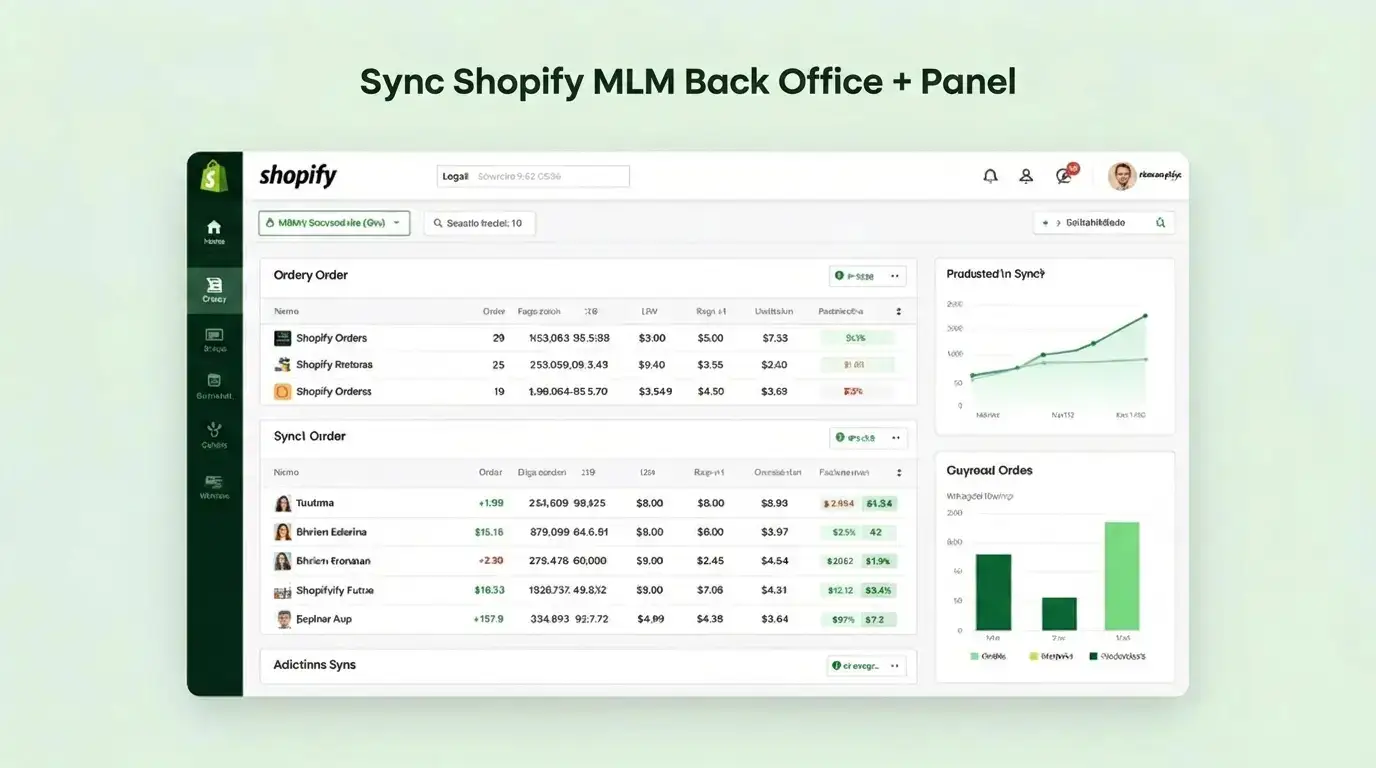
Think of it as a bridge. Shopify handles the shopping cart, payments, and product catalogue. The MLM plugin handles everything else: compensation plans, downline genealogy, commission payouts, and your distributor portal. The two systems talk through APIs, keeping data in sync in real time.
Why Integrate MLM with Shopify?
Shopify already handles checkout, inventory, and shipping brilliantly. Adding a dedicated MLM layer on top means your distributors get a professional selling experience without you needing to build an e-commerce site from scratch.
- Leverage Shopify’s trusted checkout and PCI-DSS compliance.
- Give distributors their own replicated storefronts.
- Automate commissions so you never calculate payouts by hand.
- Scale globally with multi-currency support.
Common Gaps in Shopify for MLM
- No built-in genealogy or downline tree.
- No compensation plan engine (unilevel, binary, matrix).
- No distributor-specific dashboards or KPIs.
- No automated commission reversals on refunds.
- Limited referral link management.
Key Features to Look for in Shopify MLM Software (2026)
Order & Customer Sync
Every order placed on Shopify should flow into the MLM back office automatically. Look for real-time order sync via webhooks — not batch imports that run once a day.
Example: A customer named Priya buys a wellness kit from distributor Ankit’s replicated store. The order hits Shopify, then instantly triggers a commission calculation for Ankit and his upline — no manual steps.
Commission Engine & Compensation Plans
The commission engine is the heart of any MLM system. It should support unilevel, binary, matrix, and hybrid plans. Look for rule-based configuration so you can set percentages, caps, and qualification criteria without writing code.
Example: GreenLeaf Nutrition runs a binary plan. When distributor Meena’s left leg hits ₹50,000 in sales and the right leg hits ₹45,000, the system automatically calculates her matching bonus using the weaker leg — and credits her wallet the same day.
Replicated Stores & Distributor Portals
Distributors need their own storefronts. Replicated storefronts clone your main Shopify store with a unique URL for each distributor. Orders placed through that URL are tracked back to the distributor automatically.
The affiliate portal should include performance dashboards, downline views, commission history, and rank progress. Mobile-ready portals are a must in 2026 — most distributors work from their phones.
Security, Compliance & Global Support
Your vendor should be PCI-DSS compliant for payment data. If you sell across borders, look for multi-currency support, regional tax handling, and data-residency options. GDPR and data-privacy compliance are non-negotiable for brands serving Europe or handling personal data.
Analytics & Reporting
Good reporting helps you spot trends early. Look for dashboards that show sales by distributor, team growth, rank advancements, and commission payouts — all in real time. Export-to-CSV and scheduled email reports are a bonus.
Core Features: Shopify vs Integrated MLM Solution
| Feature | Shopify Alone | Shopify + MLM Software |
|---|---|---|
| Genealogy / downline tree | Not available | Full tree view |
| Automated commissions | Not available | Real-time engine |
| Replicated storefronts | Not available | Per-distributor URLs |
| PCI-DSS checkout | Built-in | Leverages Shopify |
| Compensation plan config | Not available | Unilevel, binary, hybrid |
Benefits — Real Business Outcomes
- Faster payouts: Automated commissions mean distributors get paid on time, every time. Happy distributors stay longer.
- Lower admin costs: No more spreadsheets. The software handles calculations, rank qualifications, and bonus triggers.
- Better compliance: Built-in audit trails and commission reversal on refunds keep your books clean.
- Scalability: Start with 50 distributors and grow to 50,000 without switching platforms.
- Global reach: Multi-currency and multi-language support opens new markets fast.
Example: FreshGlow Skincare moved from manual commission sheets to an integrated Shopify MLM setup. Admin time dropped by 60%, and distributor retention improved by 25% in the first quarter.
How to Choose the Right Shopify MLM Solution
Use this step-by-step checklist before signing with any vendor:
- Map your compensation plan. Write down every bonus type and rule.
- List must-have features: order sync, replicated stores, mobile portal, reporting.
- Check API compatibility with your current Shopify plan (standard vs Plus).
- Ask for a live demo with your own product data — not a canned presentation.
- Request references from brands of a similar size and industry.
- Review the SLA: uptime guarantee, support hours, escalation path.
- Clarify data ownership and migration terms in the contract.
- Run a pilot with a small group of distributors before full rollout.
Curious how this will work for your store?
Book a 15-minute demo and we'll map your Shopify setup to the MLM plan. Includes a free data sync audit.
Typical Integration Workflow
- Discovery: Map your compensation plan and gather product data.
- Configuration: Set up the MLM engine — plans, ranks, bonuses, and rules.
- Shopify connection: Install the MLM plugin and authorise API access.
- Testing: Run end-to-end tests — orders, commissions, refunds, payouts.
- Go live: Onboard distributors, launch replicated stores, and monitor dashboards.
Pricing Models & Total Cost of Ownership
MLM software vendors typically charge using one or more of these models:
- Monthly subscription: Flat fee per month, sometimes tiered by number of distributors.
- Per-transaction fee: A small percentage or flat fee on each order processed.
- One-time setup cost: Covers initial configuration, data migration, and onboarding.
- Custom development: Hourly or project-based fees for bespoke features.
Always ask vendors about hidden costs — data storage overage, API call limits, premium support tiers, and contract lock-in periods.
Quick Checklist — Questions to Ask Vendors
- What is the guaranteed uptime SLA?
- Who owns the data if we leave?
- Is there a data migration path from our current system?
- What support channels are available (chat, phone, email)?
- Are there extra charges for adding new compensation rules later?
Frequently Asked Questions
What is Shopify MLM software and how does it work?
It is a third-party plugin or platform that connects to your Shopify store through APIs. It adds MLM features like distributor management, genealogy trees, commission calculations, and replicated storefronts — things Shopify does not offer natively.
Can I use Shopify without extra apps for MLM?
Not really. Shopify handles e-commerce well but has no built-in tools for compensation plans, downline tracking, or distributor portals. You need dedicated Shopify MLM software to bridge this gap.
Which MLM compensation plans work with Shopify?
Most integrations support unilevel, binary, matrix, hybrid, and generation plans. The best tools let you configure custom rules so you can match any compensation structure your brand uses.
How do refunds affect commissions?
A good commission engine will automatically reverse or claw back commissions when a refund or return is processed in Shopify. This keeps payouts accurate and protects your margins.
How long does an average integration take?
A basic setup can go live in 2–4 weeks. Complex setups with custom compensation plans and data migration may take 6–8 weeks. Always plan for a testing phase before launch.
Do I need Shopify Plus?
Not always. Many MLM plugins work on standard Shopify plans. However, Shopify Plus gives you better API limits, checkout customisation, and scalability — helpful for larger networks.
Is it secure for international payments?
Yes, if you pick a vendor that supports PCI-DSS compliance and multi-currency payouts. Check whether the software handles tax calculations and regional payout rules for each country you sell in.
Can you integrate with my existing Shopify store?
Yes. Our custom Shopify MLM app connects to your existing store via secure API integration. We don’t require you to rebuild anything — we add the MLM functionality on top of your existing Shopify setup.
Final Recommendation
Running network marketing on Shopify is absolutely possible — you just need the right Shopify MLM software to fill the gaps. Focus on real-time order sync, a flexible commission engine, and mobile-ready distributor portals. Ask for a live demo with your own data, check integration details, and run a pilot before going all in.
The market has matured. In 2026, you don’t have to build from scratch or rely on spreadsheets. Pick a vendor, plug it into Shopify, and let the software do the heavy lifting.
PCI-DSS compliant • 24/7 support • Multi-currency ready
On this page